How AI is Changing the Future of Digital Marketing

Artificial Intelligence is shaping the future of digital marketing and as consumers and marketers, we can be excited to see what will change over the next couple of years. Artificial intelligence helps companies to address consumer acquisition which is certainly a challenge for marketers. It can also spot trends and predict them for the future and help a company allocate their budgets and who they should target, this way brands can reduce costs of time and money and spend their time on high value work. 

By applying artificial intelligence, companies can continue to produce smarter, more targeted advertisements as well as increase sales and save money in the process.

Artificial Intelligence will lead to a more advanced business strategy for marketers as:

  • 61% of marketers say Artificial Intelligence is the most important aspect of their data strategy. 
  • 80% of business and tech leaders say Artificial Intelligence already boosts productivity.
  • Current AI technology can boost business productivity by up to 40%.
  • 97% of mobile users are using AI-powered voice assistants
  • 83% of early AI adopters have already achieved substantial (30%) or moderate (53%) economic benefits. (White, 2021)

Marketing agencies are now able to use artificial intelligence to analyse data, predict trends, and enhance the quality of their brand and as a result of this, the way a brand conducts digital marketing campaigns is changing quickly and isn’t stopping for anyone. 

One of the main ways artificial intelligence will impact digital marketing in the future is content creation. This will be done through a field known as content intelligence where artificial intelligence tools will offer data driven insights and feedback to content creators. Therefore, marketers and also influencers will be able to enhance their content creation efforts and produce greater analytics. Artificial intelligence will be able to impact content creation by drafting optimised social media posts, write data driven blog posts for better rankings, personalise emails and conduct an effective keyword research. 

Artificial intelligence, with the use of machine learning, will also help to improve product recommendations online. This way, marketers will have the ability to make timely and improved predictions on what products the consumers will purchase. Many online companies are already using this function through the use of cookies, consumers will find product recommendations for products they may have already viewed on their social media platforms. Artificial intelligence powered product recommendations can help your company grow as it will save the consumer time on having to manually selecting recommended products, making them more likely to stay loyal and recommended your brand by using word-of-mouth and boost conversions and increase the value of each sale. 

Email optimization is the final way that artificial intelligence will change the future of digital marketing as artificial intelligence systems make email marketing more effective by increasing revenue and decreasing costs. To make your email marketing campaigns more successful and profitable, marketers can use artificial intelligence powered email marketing tools to help increase the click through rates. 

Bibliography

White, C., 2021. How AI is Changing the Future of Digital Marketing (2022). [Online] 
Available at: https://www.bramework.com/ai-marketing/
[Accessed 22 November 2021].
AI & Security

“With technology making lives easy day by day, cybercriminals too are finding innovative ways to get into our lives. Along with the ease of access, security and privacy are also imperative in this digital age, where our lives are connected with IoT devices.” (CisoMag, 2019)

Artificial Intelligence and machine learning are now becoming essential to information security because these technologies are capable of swiftly analysing millions of data sets and tracking down a wide variety of cyber threats that may result in a phishing attack. Phishing is the means of stealing login credentials or credit card numbers. It often comes from fake email links or fraudulent text messages, e.g. AIB scam text messages.

There are two types of cyber crime targets; Hard infrastructure- defence installations, nuclear facilities, electrical and telecommunications network, manufacturing plants. Soft infrastructure- banks, private firms, public record systems, health and insurance record systems. Attacking hard targets aims to cripple essential infrastructure within an industry or society, however, attacking soft targets aims to disrupt, embarrass or punish firms.

Hackers are turning to Artificial Intelligence and using it to weaponise malware and attacks to counter the advancements made in cybersecurity solutions. Hackers program codes to execute at a specific time and date after an application has been installed or when a targeted number of users have subscribed to the application. This is to maximise the impacts the attacks will cause.

If an activity is central to a persons identity (e.g. driving, playing sports, cooking), then they are less likely to adopt artificial intelligence during their personal activities. For example, people would rather read from a recipe book then have a smart home device read it for them. Women tend to perceive more risk generally and are more risk averse than men and are therefore less likely to adopt artificial intelligence than men.

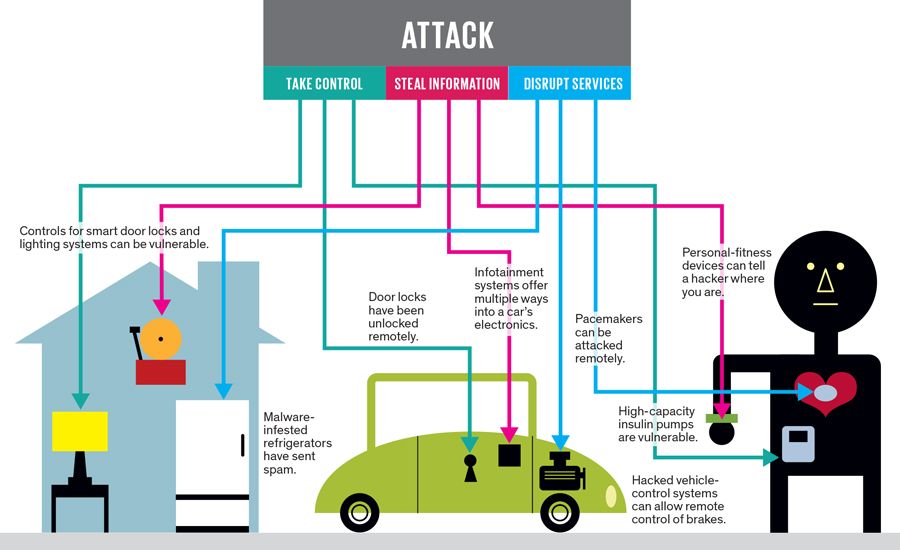
The irony, of course, is that artificial intelligence begins with human input and programming and is then manipulated by humans or by the programme itself. For example, to speak more about artificial intelligence in the home, in 2020 there were multiple reports of people hacking into the Amazon Ring doorbell. Ring is a home security company that was acquired in 2018 by Amazon. They sell devices from a $34 flood alarm to a $499 doorbell that allows users to see, hear and speak to visitors. While the Ring gadget is designed to make people feel safer in their homes, the people connected to this particular lawsuit have stated that it put their families at risk.  The unknown voice commented on the kids’ basketball game and encouraged them “to get closer to the camera,” according to the lawsuit. (Evans, 2020). Below is an example of how your smart home devices may be affected with the possibility of being hacked, from cars, lights in your home to even a pacemaker.

How to Build a Safer Internet of Things - IEEE Spectrum

References Alan Grau, (2015), How to Build a Safer Internet of Things. https://spectrum.ieee.org/how-to-build-a-safer-internet-of-things CisoMag, (2019), Hackers Take Over Smart Home. https://cisomag.eccouncil.org/hackers-take-over-smart-home/ Erica Evans, (2020), Heres what you need to know about recent Amazon Ring hacking cases. Deseret News https://www.deseret.com/indepth/2020/1/3/21043653/amazon-ring-hacking-cases-doorbell-santa-claus-kids-bedroom-safe-lawsuit-security-camera-home-hacker

Past, Present & Future of AI

The concept of artificial intelligence has been around for centuries, however, it wasn’t until the 1950’s where the true possibility of it was explored “British Polymath, Alan Turing, suggested that if humans use available information, as well as reason to solve problems and make decisions- then why can machines do the same thing”. (Aguis, 2019)

By 1974, computers had begun to expand and flourish as they were now faster, more affordable, and able to store more information. Further research in artificial intelligence showed promise towards he goals of problems solving and the interpretations of spoken language in machines, yet there was still a long way to go before machines could think on their own, self recognise and achieve natural language processing. In the 1980’s, expert systems were introduced which mimicked decision making processes of a human expert, but it was not till the 2000’s that many of the landmark goals were achieved and artificial intelligence thrived, despite the lack of government funds and lack of attention.


Past, Present and Future of Artificial Intelligence | ITeXchange Blog

Over the past 5-10 years, we have seen a significant resurgence in artificial intelligence technologies. Innovation is happening at a rapid pace with leaders such as Google using deep learning algorithms in neural networks to generate predictive models and algorithm marketplaces driving a new level of access to artificial intelligence toolkits like never before. “In today’s day, AI research is constant and continues to grow. Over the last five years AI research has grown by 12.9% annually worldwide.” (Aguis, 2019)Research shows that within the next four years, China is predicted to become the biggest global source of artificial intelligence, taking over the United States and Europe. These days, there is so much that artificial intelligence is being used for and so much more potential there that is it hard to picture our future without it- especially when it comes to businesses and marketing. 

Artificial intelligence can collect and organise large amounts of data to make insights and guesses that are beyond the human capabilities of manual processing. Recently, AI is said to reduce costs in many ways- for example, using chat bots on your website can reduce the training you need to provide to your staff; therefore, it will replace that job and save your business money in the long run. 

It is said that smarter technologies in our workplaces will be able to visualise the entire production chain and make decisions autonomously. “Our workplaces and organisations are becoming “smarter” and more efficient as machines, humans are starting to work together, and we use connected devices to enhance our supply chains and warehouses. (Aguis, 2019)

Bibliography

Aguis, C., 2019. Evolution of AI: Past, Present, Future. [Online] 
Available at: https://medium.datadriveninvestor.com/evolution-of-ai-past-present-future-6f995d5f964a
[Accessed 29 October 2021].

Artificial Intelligence

For this weeks blog upload, I would like to speak more about how Artificial Intelligence is becoming more and more frequent in out lives. Today, Artificial Intelligence is being used more and more frequently in marketing. Artificial Intelligence in marketing is the process of utilising data models, mathematics and algorithms to generate insights that can be used by marketers. Marketers will use Artificial Intelligence derives insights to guide future decisions about campaigning spending, strategy and content topics. Artificial Intelligence in marketing can be used in planning, production, personalisation, promotion and performance.

Over the last 5 years, jobs requiring Artificial Intelligence have increased by 450%. According to Forbes, top-performing companies are more than twice as likely to be using AI for marketing (28% vs. 12%). According to adverity.com, in just 2 years, chatbots will take over 85% of customer service interactions. In comparison, Artificial Intelligence handles about 30% of it right now. Some website examples that use customer service chatbots are Apple, LifeStyle Sports and Spotify.

Some Pros and Cons of Artificial Intelligence in marketing are: Pros- Data is analysed faster as Artificial Intelligence programmes can analyse complex data sets faster than a human. However, increased speed does not mean greater efficiency. As a result, businesses could launch more effective campaigns faster and deliver a higher return on investment at a lower cost. Pros- The personalisation of products is a pro of Artificial Intelligence in marketing and can include identifying possible potential customers based on data such as purchase history, demographics, location, etc. It may include tracking and customer data with the products themselves. Cons- Consumers don’t always like the idea of customer service chatbots or speaking to automated computers on the phone. Chatbots should be used with care based on your target audience and supported by a live human as often as possible. Cons- Artificial Intelligence in marketing can cause fewer jobs as you may not need to employ as big of staff team. However, even though Artificial Intelligence has cost some people their jobs, in the long run, it has and will create more jobs and may save the business money.

AI Marketing: New Technology To Maximize Business Results
Source:https://thekeenfolks.com/artificial-intelligence-marketing/

In the future, Artificial Intelligence will mainly affect targeting, personalisation and programmatic advertising and surprisingly, instead of eliminating jobs, experts predict that Artificial Intelligence will generate 2.3 million new employment opportunities, although many do feel anxious about machines potentially replacing their jobs whereas, others have began to worry that Artificial Intelligence powered systems (e.g. Alexa or the ring doorbell), are spying and gathering data about their new campaign ideas.

For my next blog, I will be speaking more about average items in our homes, converting into Artificial Intelligence items.

E-Commerce – Blog 1

For my blog series this semester, I would like my main focus to be around Artificial Intelligence in E-Commerce and Digital Marketing. I would like to begin my first blog by spending some time speaking about E-Commerce as a seperate and Artificial Intelligence as a separate.

“E-Commerce is all electronically mediated information exchanges between an organisation and its external stakeholders.” E-Commerce encompasses all electronically medicated transactions between the organisation and any third party. Therefore, non-financial transactions such as customer support (i.e. Boohoo customer support account on Twitter), or information requests should also be considered under this definition.

There are four perspectives of E-Commerce which include; Communications- delivery of information products or services or payment by any electronic means (e.g. Apple Pay, Visa contactless etc). Process- application of technology towards the automation of business transactions and work flows. Service- enabling cost cutting at the same time as increasing the speedy and quality of service delivery. Online- buying and selling of products and information online.

Brand building websites are a good way to provide an experience to support the brand. For example, to introduce the AI sector of my blog, Ikea has recently introduced a Virtual Reality experience that allows consumers to test Ikea products in real time through Apples iOS 11 ARKit technology. “The app automatically scales products, based on room dimensions with 98 per cent accuracy.” In order to visualise a product within a space, the application scan the expanse of a room through an iPhone or an iPad camera. Users can then browse through over 2000 Ikea products on an online database to make their selection. Once chosen, users must point the device to the desired location in the room and drag and drop the selected product(s) onto the space. Users can then add the products they have chosen to their online basket. Dulux also introduce the Deluxe visualiser app which allows users to pick a colour from anywhere and, with augmented reality technology, allows you to see the colours live in your living space. Dulux can also offer suggested colour schemes to help complete your look and you can buy the testers or pain and have them delivered directly to your doorstep.

Artificial Intelligence is “the theory and development of computer systems able to perform tasks normally requiring human intelligence, such as visual perception, speech recognition, decision-making, and translation between languages.” Artificial Intelligence is the simulation of human intelligence processes by machines, especially computer systems. Artificial Intelligence is important because it can give businesses insights into their operation that they may not have been aware of as generally Artificial Intelligence can perform tasks better than humans and Artificial Intelligence tools often complete jobs quickly and with relatively few errors.

A few examples of Artificial Intelligence at home are of course the infamous and Google Home. Businesses may often use chatbots on their websites if a user needs help, i.e. Apple Live Chat.

Next week for my second blog upload, I hope to speak more about Artificial Intelligence and focus mainly around Artificial Intelligence in our homes and how it is slowly making an impact on our daily lives by comparing the positives and negatives.